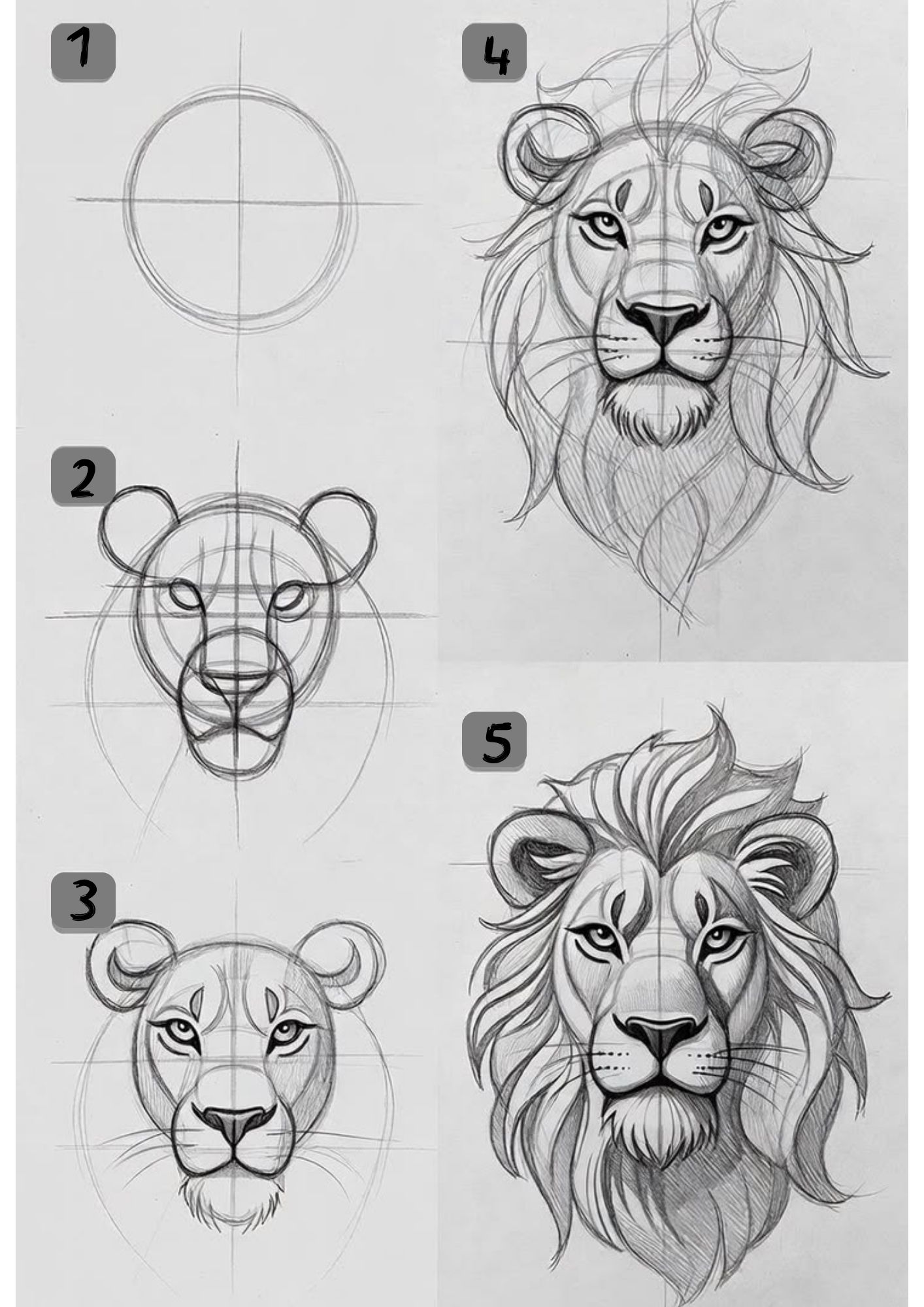
How to Draw a Realistic Lion with Pencil
A realistic lion drawing becomes much easier when you work from large shapes to small details. Instead of drawing every hair immediately, first establish the head, facial proportions and major shadow areas. Then develop the mane and fur gradually. This method helps the finished lion look solid rather than flat.
Materials
A regular sketchbook or drawing paper, an HB pencil for construction, a 2B or 4B pencil for darker values, an eraser and a sharpener are enough to begin. Keep your first lines light so they can be corrected easily.
Step 1: Sketch the Basic Lion Head Shape
Begin with a light circle or oval for the main skull. Add a vertical center line and a horizontal eye line. Block in the muzzle below the center of the face. Avoid pressing hard at this stage—the purpose is to establish proportion and symmetry.
Step 2: Place the Eyes, Nose and Muzzle
Use your guidelines to position both eyes at the same level. Lions have a broad nose and a strong muzzle, so compare the width of these features before adding detail. Check the distance between the eyes, nose and mouth several times.
Step 3: Build the Mane as Large Shapes
For a realistic lion face, the mane should frame the skull rather than look like a ring of identical lines. First draw the outer silhouette and the main clumps. Observe how hair flows outward and downward from different areas of the head.
Step 4: Add Shading and Realistic Fur Texture
Identify the darkest areas around the eyes, nose, mouth and deeper parts of the mane. Build midtones slowly with controlled pencil pressure. Use short strokes that follow the direction of the fur, but leave some quieter areas so the drawing does not become uniformly busy.
Step 5: Refine Highlights and Final Details
Deepen only the darkest accents and sharpen selected edges around the eyes, nose and important mane strands. Preserve lighter paper for highlights. A few carefully chosen details usually create more realism than drawing every single hair.
Common Mistakes When Drawing a Realistic Lion
One common mistake is adding fur before the facial structure is correct. Another is making both sides perfectly identical; natural faces contain subtle variation. Also avoid using the same pencil pressure everywhere. Realistic drawings need a range from light values to deep darks.
Practice Tip
Compare your drawing with your reference often. Look at angles and distances rather than naming features. If the basic proportions work, realistic shading and texture become much easier.